
Eucalypt of the year 2026 – Our Eucalypt Home
Image © Catherine Cavallo
Eucalypt of the year celebrates the beauty and importance of Australia’s iconic eucalypts. This annual event highlights the incredible diversity of these trees and their significance to our landscapes, biodiversity and heritage.
Eucalypt of the Year 2026 – Our Eucalypt Home – Congratulations to the Marri! Corymbia calophylla
Unique. Irreplaceable. Treasured.
Think it’s only humans that yearn to find their dream home? Ask a Koala, Swift Parrot or Murray Cod what they need to survive and you’ll find that a gum tree fits the bill. Eucalypts support our Australian wildlife in a surprising number of irreplaceable, ingenious and often invisible ways. With little fanfare, these quiet achievers keep our unique animals, plants and fungi fed, watered, sheltered and safe. And with an abundance of threats to our eucalypts, it’s up to us to protect these iconic trees and the irreplaceable role they play in Australia. After all, home is where the gum is!
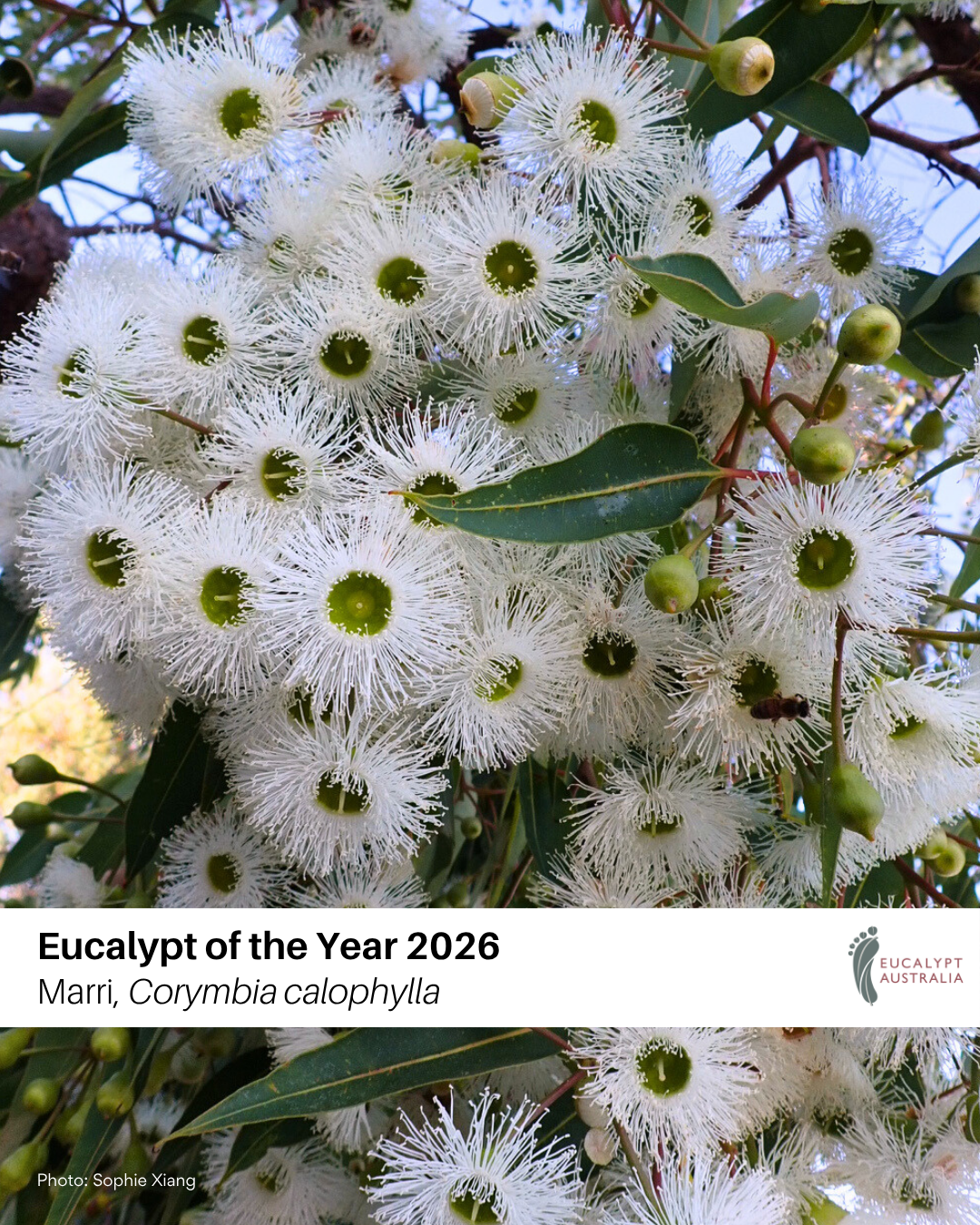
Eucalypt of the Year 2026 – Our Eucalypt Home – Congratulations to the Marri! Corymbia calophylla
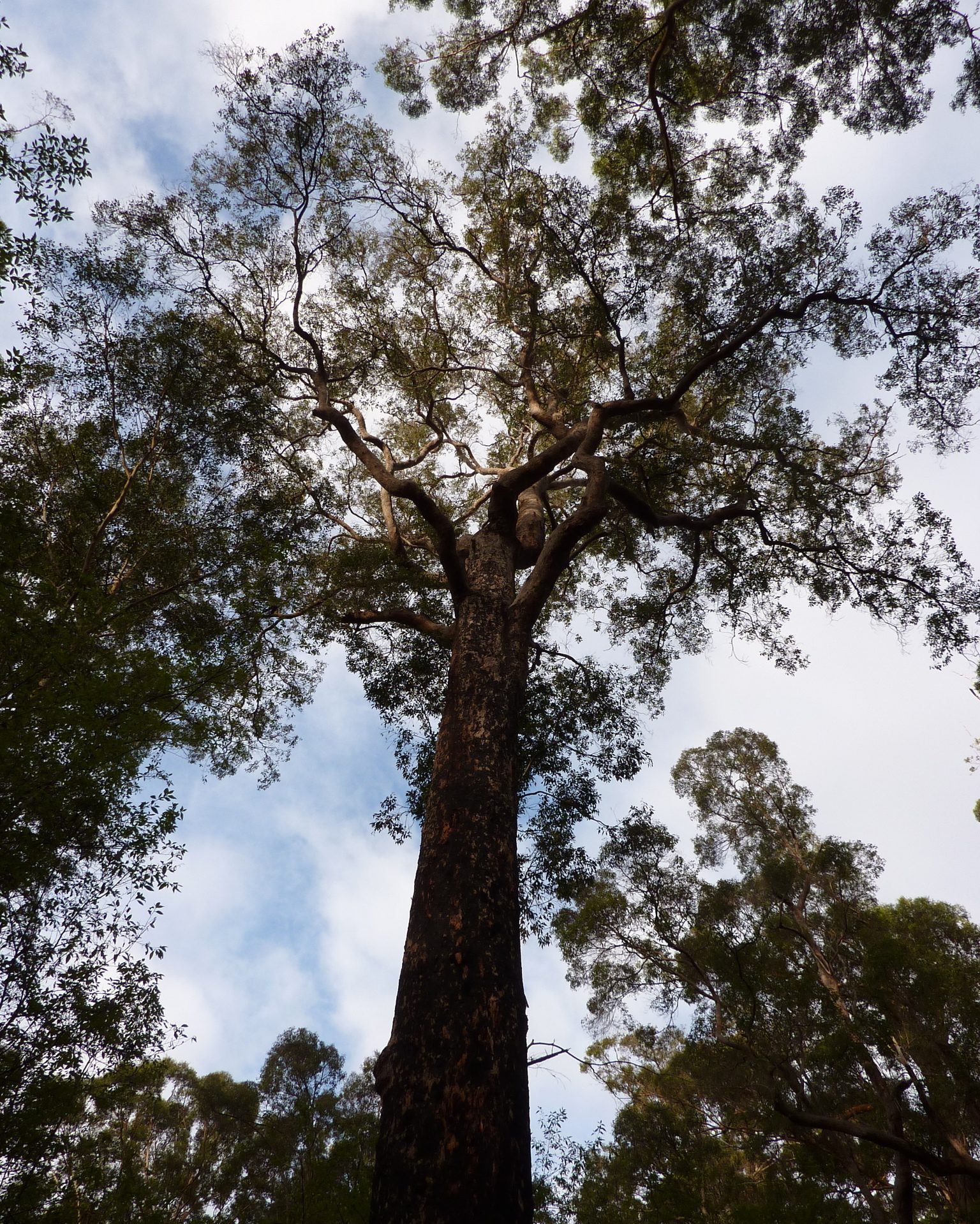
Massive Marri blossoms are a keystone nectar and pollen resource across the Swan Coastal Plain, Darling Range, and surrounding forests and woodlands. Research by Dr Kit Prendergast and colleagues found that at least 81 species of native bees visit Marri flowers, often as the main—or only—plant they forage on, especially late in the season when other blooms have finished. Many bees also nest in small cavities and roots around Marri trees, and some even use its red sap (kino) in their nests.
The huge, urn-shaped ‘honky nuts’ hold seeds that are a major food resource for local parrots, including three threatened black-cockatoo species: the Carnaby’s (Endangered), Baudin’s (Critically Endangered), and Red-tailed Black Cockatoo (Threatened subspecies), as well as the Red-capped Parrot.
Whether straight and tall in forests or hunched and gnarled in woodlands, the Marri also provides the deepest and widest tree hollows in southwestern landscapes. The oldest, largest hollows are critical nesting habitat for black-cockatoos, some used over decades—but they can take centuries to form.
Other hollow users include the Critically Endangered Western Ringtail Possum, microbats, reptiles, and invertebrates.
Fallen Marri timber is an important habitat feature of Marri and Jarrah-Marri forests, contributing shelter and nutrients to the forest floor. Chuditch (Western Quoll) and Mardo (Yellow-footed Antechinus) nest and shelter in large Marri logs, while Quenda (Southern Brown Bandicoot) and Western Death Adders rest camouflaged in the thick leaf litter. Sadly, the essential goods and services Marri provides are under pressure from land-clearing, as well as climate-driven fire, drought and borer attacks. Protecting old trees safeguards food, shelter, and pollinators for the whole forest.

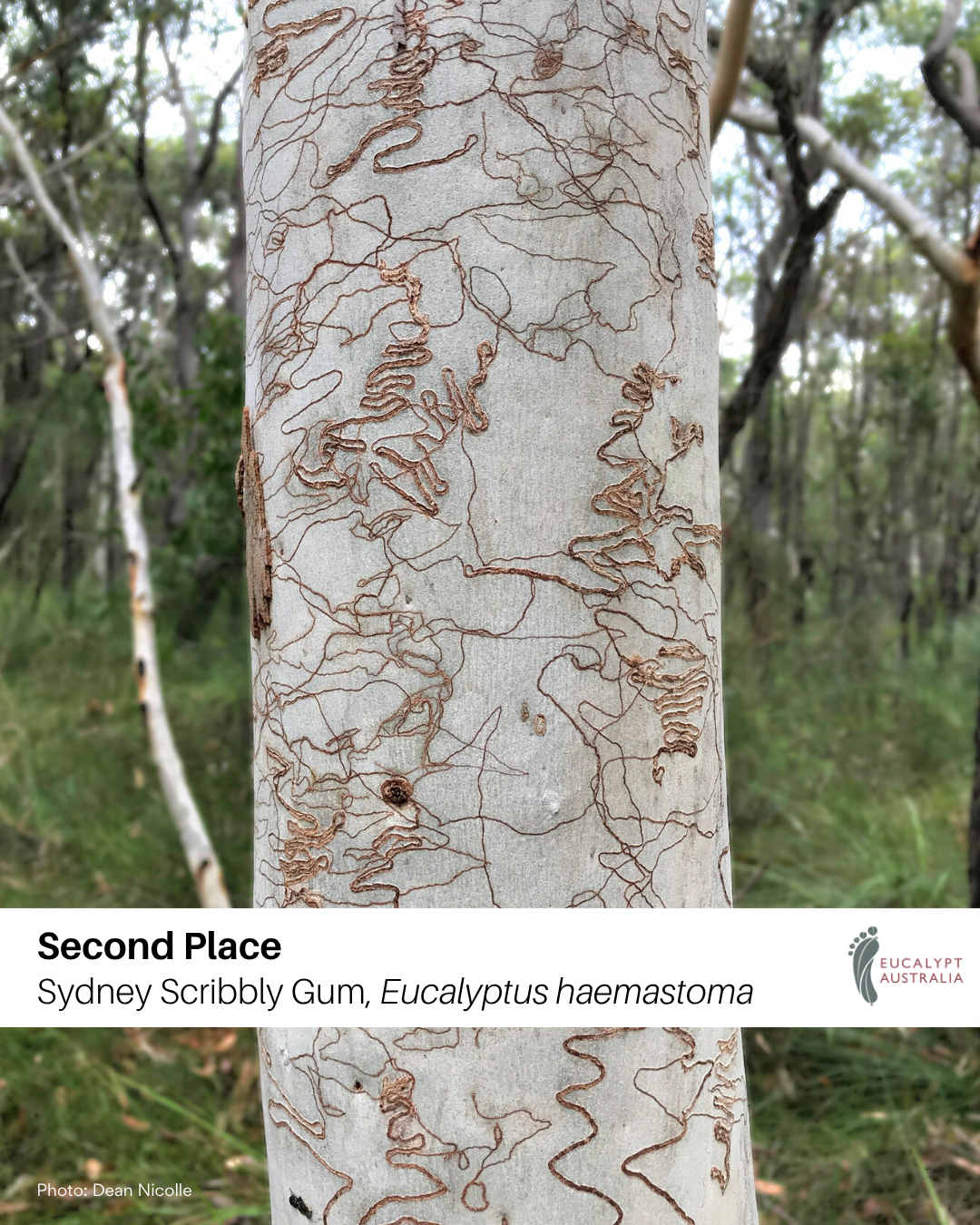
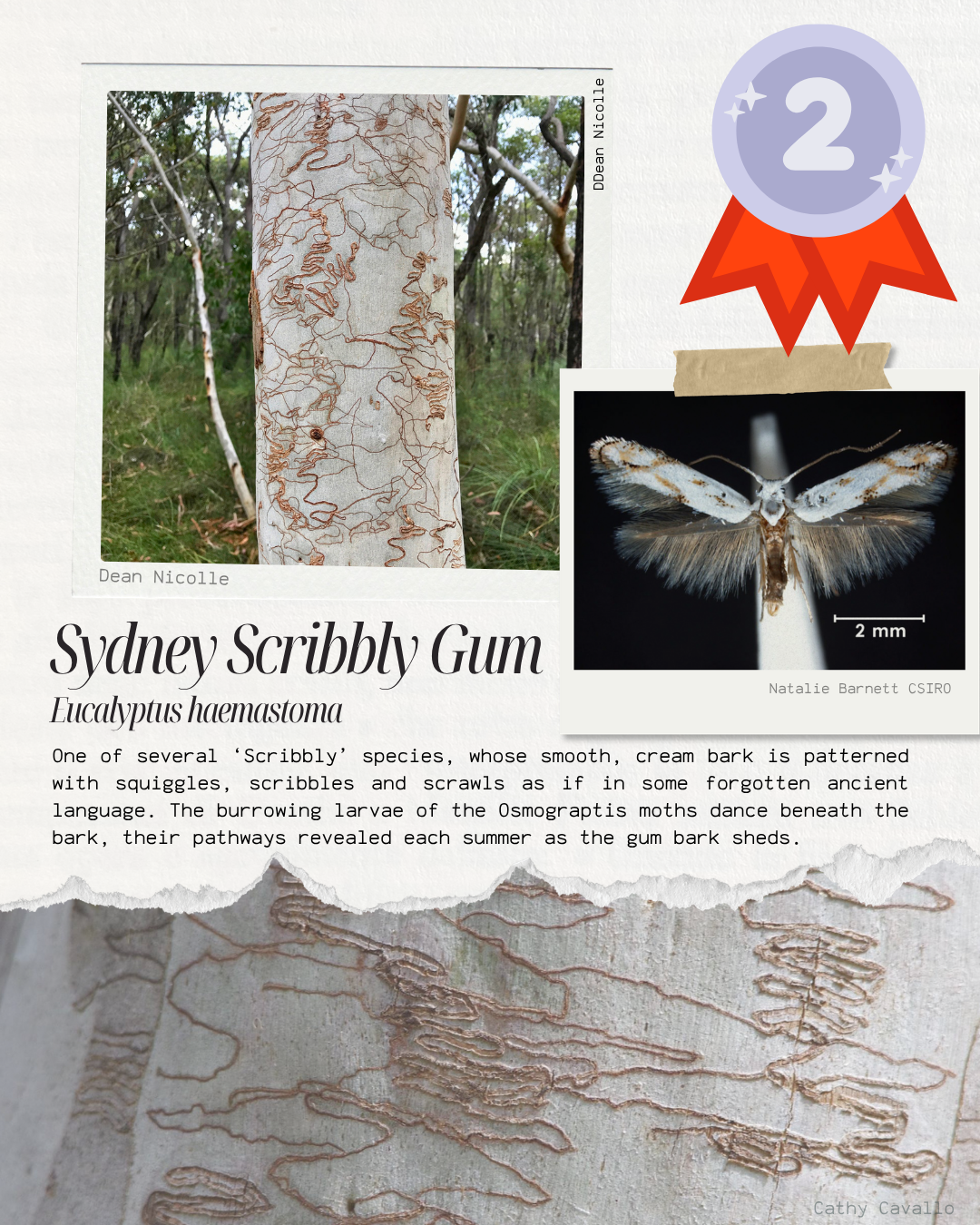
Eucalypt of the Year 2026 – Our Eucalypt Home – And in second place… Sydney Scribbly Gum!Eucalyptus haemastoma
Those mysterious squiggles on scribbly gum bark aren’t graffiti, nor the bulletin boards of May Gibbs’ gumnut babies — they’re the work of tiny moth larvae.
The female Scribbly Gum Moth (Ogmograptis spp.) lays her eggs under the bark of a scribbly gum in autumn. Under the protective bark, the larvae are protected from the winter chill, and tunnel in the growing wood, feeding on scar tissue the tree produces as it heals. The trails start out as tiny scratchings, and widen as their creator grows. When the old bark is shed the following summer, the larvae fall into the leaf litter to pupate and their winter wanderings are revealed.
Thanks to scientists at CSIRO, at least 14 species of scribbly gum moth are known, and the marks only appear where these insects occur — mostly across eastern Australia.
Sydney Scribbly Gum is one of several trees famous for these patterns, along with Inland Scribbly Gum (Eucalyptus rossii) and Narrow-leaved Scribbly Gum (Eucalyptus racemosa). Scribbly gum moths also use other eucalypts, including Snow Gums. This is why you can spot scribbles on gums in Tasmania, where none of the three species of ‘Scribbly Gum’ grow.
Beyond their iconic artwork, these trees support important bushland food webs. Their simple white flowers feed insects, honeyeaters and flying-foxes, their leaves support Koalas and herbivorous insects, and older trees develop hollows used by parrots, possums and microbats.
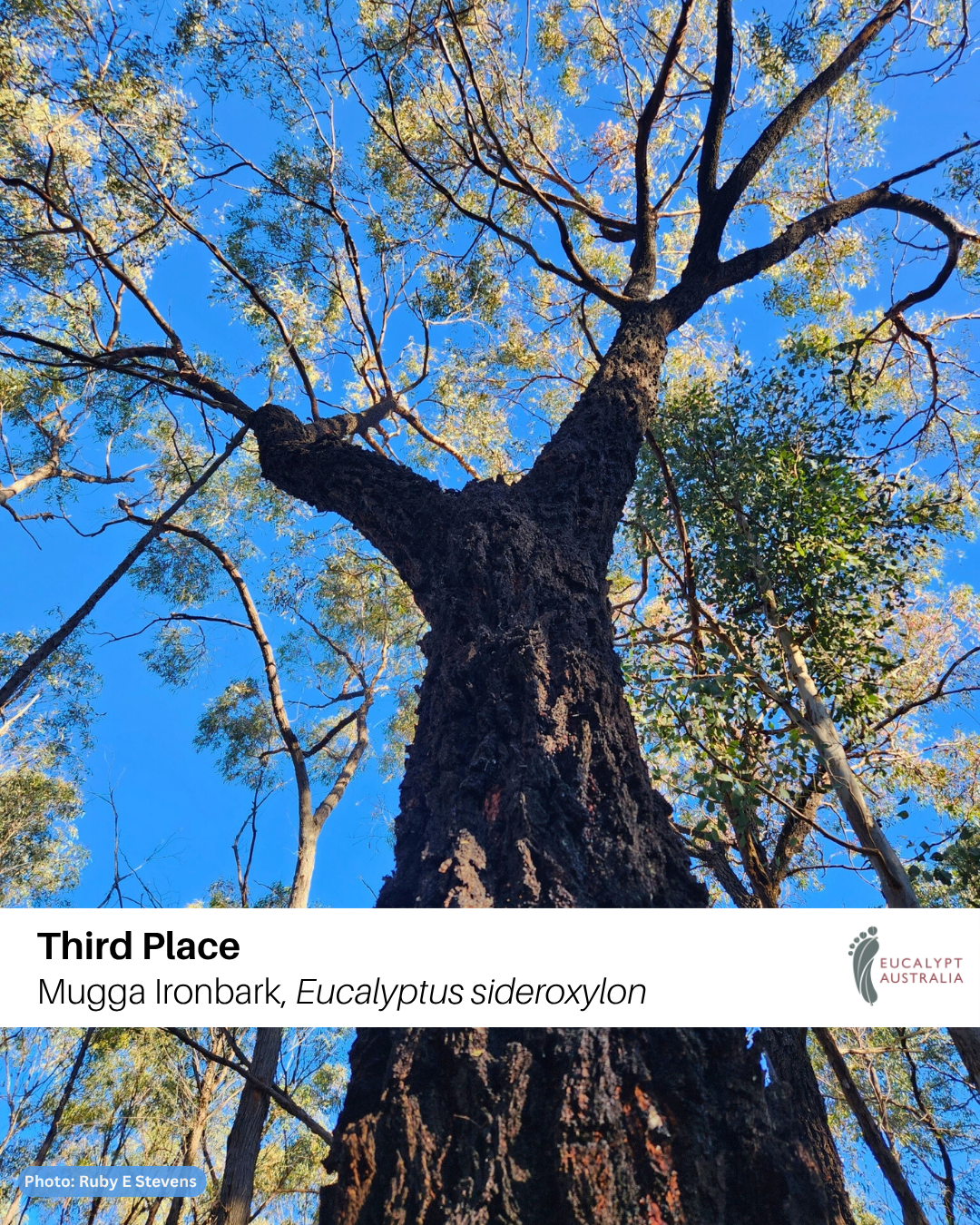
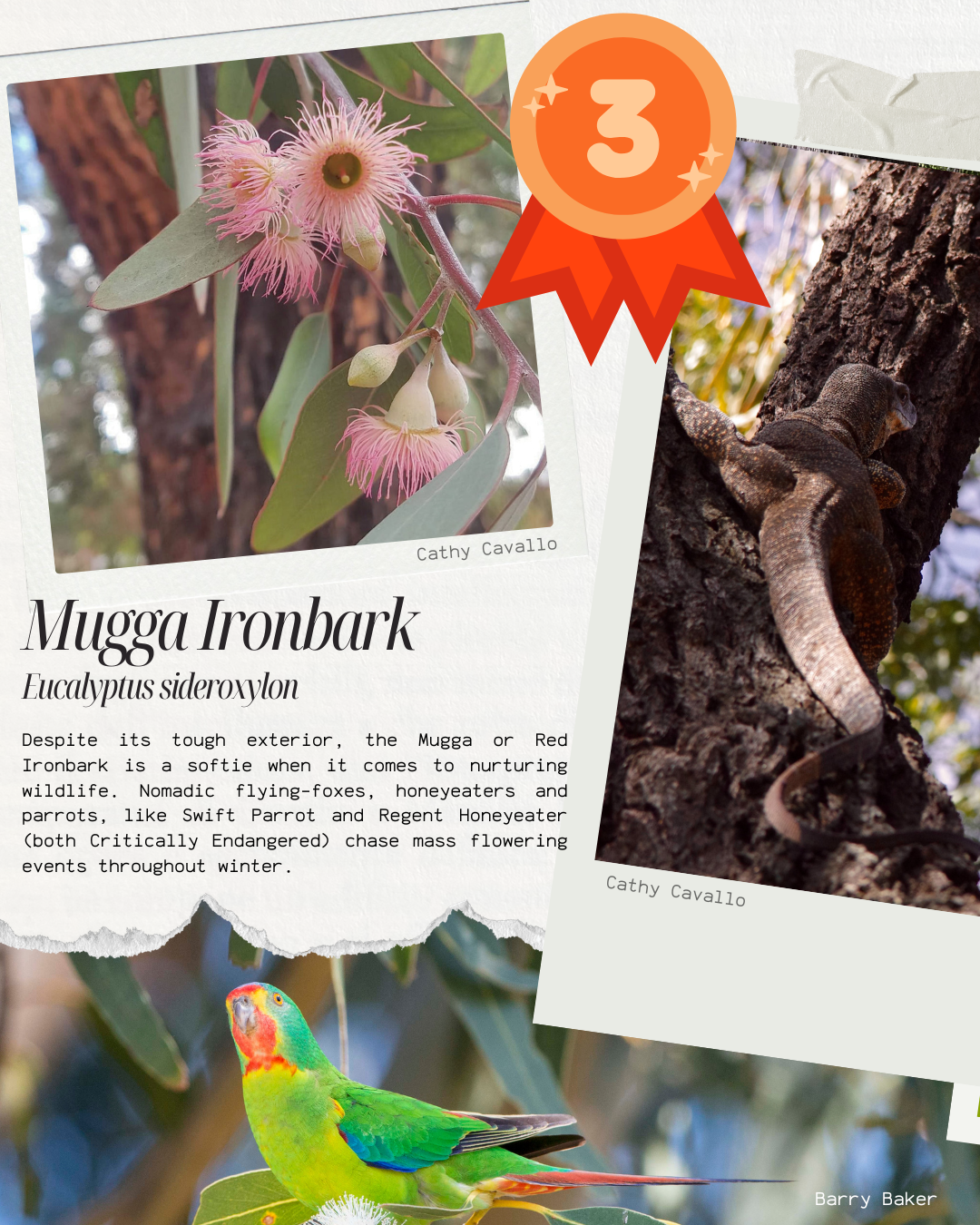
Eucalypt of the Year 2026 – Our Eucalypt Home – And in third place… Mugga Ironbark!Eucalyptus sideroxylon
It’s impossible to pass an ironbark with that thick, dark, rugged bark and pendulous grey-green foliage and not be impressed.
Unlike smooth-barked gums, the ironbarks retain their bark, building a thick protection against fire and sap sucking insects and mammals. Those deep furrows in the tough bark provide shelter for foraging lizards and invertebrates and make it easy for predators like the Lace Monitor to scale the trunks and seek out nests full of eggs.
Winter flowering means that the true magic of this species is on show during winter. When so much else falls silent, the Box-Ironbark forests come alive.
During these colder, darker months, the Mugga Ironbark provides essential food for critically endangered Swift Parrots and Regent Honeyeaters. It is also an important food tree for flying-foxes, especially the Grey-headed Flying Fox.
In turn, these animals are significant pollinators of the species and other ironbarks.
Flying-foxes, Swift Parrots, and Regent Honeyeaters are nomadic, traveling far and wide between patches of flowering trees. This helps the trees send their pollen, and therefore, their genetic material, further afield to pollinate more distantly related trees. Pollination between distantly-related individuals (called ‘outcrossing’) creates stronger offspring that are more vigorous and more likely to survive. It enhances genetic diversity throughout the ironbark’s range, which is important for the long-term survival of the species.
Eucalypt of the Year 2026 – Our Eucalypt Home – Learn more about the Contenders
Unique. Irreplaceable. Treasured.

Darwin Stringybark (Eucalyptus tetrodonta), NT
The Darwin Stringybark is one of the dominant trees in Australia’s tropical savanna, The straight trunks of this medium tree are favoured by termites, which hollow out the timber and return nutrients to the soil. The tree lives on, and threatened species like the Black-footed Tree Rat and Palm Cockatoo make their homes in the hollow. The straight tubes of termite-affected trees are perfect for making didgeridoos. An infusion of the bark can be used as a treatment for dysentery , while a mashed paste from the leaves can be used for headache and fever. The Darwin Stringybark is also a key nectar source for flying foxes, possums, tree rats, honeyeaters and parrots at a time of year when little other food is available.
Threatened by gamba grass burns, land clearing and unsustainable commercial harvest for cheap didgeridoos.
Image © Dean Nicolle

Mountain Ash/Swamp Gum (Eucalyptus regnans), Vic, Tas

Scribbly Gum (Eucalyptus haemastoma), ACT, NSW
Long have ecologists and artists alike been fascinated by the intricate patterns wending their way back and forth across the Scribbly Gum’s smooth, powdery bark. In the 1930s CSIRO scientists discovered the artist behind these works to be the larvae of the tiny Osmograptis moth. But it wasn’t until 2012 that they worked out how the moth larvae created their written messages, by tunnelling just below the bark and feeding on the next year’s growing wood.
Image © Dean Nicolle

River Red Gum (Eucalyptus camaldulensis) Vic, NSW, Qld, SA, NT, WA, ACT
Who doesn’t this tree provide for?! From bringing water up from deep water tables and channeling it across desert landscapes, to providing leaves, nectar, pollen, sap and wood for hungry wildlife, and playing host to hollow-nesting species from tiny pardalotes, microbats and budgerigars to massive Powerful Owls, Lace Monitors and black cockatoos! In rivers, fallen River Red Gums and living roots create sheltered zones for Murray Cod and Golden Perch to mate, spawn and ambush prey.
Image © Sue Dowling

Manna Gum/ White Gum (Eucalyptus viminalis), Vic, Tas, NSW, SA

Forest Red Gum/ Queensland Blue Gum (Eucalyptus tereticornis), Qld, NSW, Vic

Mugga Ironbark (Eucalyptus sideroxylon), Vic, NSW, ACT, QLD

Kingscote Mallee (Eucalyptus rugosa), SA
Marri (Corymbia calophylla), WA
Small-fruited Red-mahogany (Eucalyptus resinifera), QLD, NSW

2025 Winner - The Travel Edition - Wondrous Forests of the Walpole Wilderness
Wondrous Forests of giant Tingle and Karri forests to ancient Jarrah, Marri, and Red-flowering Gum woodlands!
Receiving over a metre of rain annually, the Walpole Wilderness grows some of Australia’s most enormous eucalypts. With tall forests on hilltops, unique peatlands in lowlands, and woodland slopes, it’s home to 45+ Eucalyptus species and two Corymbias!
Amongst the gums dwell some very special native wildlife, like the beautiful Sunset Frog – found only in the region’s peat wetlands – the reclusive southern forest Quokkas and the tiny Pygmy Tingle Trapdoor Spider, which lives in equally tiny burrows in Tingle bark.
Image: Liz Edmonds

2024 Winner - the incredible Red-Flowering Gum, Corymbia ficifolia,
This Western Australian showstopper is one of the most widely planted eucalypts in Australia and around the world! In the wild, however, it is only found in a very small area of subcoastal woodland and heathland in far southwest Western Australia.
It has dark, glossy leaves reminiscent of a fig tree – hence the name fici (ficus or fig-like) folia (leaves). The huge red or orange blossoms cover the ends of branches in an epic show of summer colour, before falling to reveal huge woody gumnuts.
The Red-flowering Gum is a fantastic choice for streets, parks and gardens, and there are even dwarf varieties that can be grown in pots! Dwarf varieties grow to between 2 and 4 metres (on average) and others can grow up 12 metres although averages don’t always to individuals! It has a dense, shade-giving canopy and dark, non-shedding bark. Hybrid and grafted cultivars exist across a range of pinks, oranges and reds and can be planted in a wider range of climates and soils than the wild Red-flowering Gum.
Image: Linda Baird

2023 Winner - the exquisite Sydney Red Gum - Angophora costata

2022 Winner - the Mighty Mountain Ash - Eucalyptus regnans

2021 Winner - The "Sexy" Gimlet - Eucalyptus salubris

2020 Winner - The Stunning Illyarrie - Eucalyptus ethrocorys

2019 Winner - The Tenacious Snow Gum - Eucalyptus pauciflora

2018 Inaugural Winner - the Majestic River Red Gum - Eucalyptus camaldulensis
In flooded rivers, their roots protect young fish from predators, while high in the branches birds and possums play. A scar or broken bough becomes a hollow home for marsupial, reptile or bird and submerged logs host giant barramundi and Murray cod.
Image: Catherine Cavallo

Contact
The Bjarne K Dahl Trust
Operating as Eucalypt Australia
Level 6, 126 Wellington Parade,
East Melbourne, Vic, 3002
T: 0477 958 493
Socials
